● FOR COMPANIES
Sustainable performance for international teams.
I help teams perform under pressure, handle constant change, and hit ambitious goals while keeping engagement high and preventing burnout.
Workshops for teams in Munich, across Europe, or online. In English, German and Polish.
“She speaks the language of business, not theory.”
SVP Customer Success DACH, Radancy
● THE PROBLEM
Ask three people what’s wrong. You get three different answers.
I talk to HR directors, managers and team members every week. They describe the same problem from three different chairs.
Sound familiar?
What the team says
“I sit in meetings all day. I do my actual work in the evening.”
“I don’t think anything I do here actually changes anything.”
“Something changes every few months. I’ve stopped listening.”
What the manager says
“My team brings me problems. Never solutions.”
“I don’t really know what my team thinks. I find out when someone resigns.”
“I’ve got more people to look after than ever, and half my week is admin. When am I supposed to lead?”
What HR says
“Our engagement survey came back low. Now I have to do something with it.”
“Sick days keep climbing, and I can see exactly which teams.”
“Every person who quits costs us months and a lot of money to replace.”
● MY APPROACH
Sustainable performance means taking care of four areas.
adaptability
Communication
Paul Watzlawick said you cannot not communicate. Even saying nothing says something.
So I show your team frameworks they can actually use, and we practise them on their own cases. They all sound easy on paper. It gets much harder in a real conversation.
Ownership
“Nobody takes ownership, everything comes back to me.” That’s the complaint I hear most from managers.
So I work on both sides. With your team, on why it’s worth leading from every seat, and how to notice when you’re waiting for permission. With managers, on how to let go, because ownership doesn’t grow if you take the decision back.
Resilience and adaptability
Both are skills, and skills are trainable. Right now they are worth more than Excel.
This is also the part that pays you back in money. Fewer sick days, fewer people burning out, fewer people to replace.
Trust
In a hybrid or fully remote team, trust still has to be built, and it doesn’t happen by itself through a screen.
The real conversations we have during my workshops are what make it possible.
● MY METHOD
Why international teams
I’ve been an expat for 10 years, and I spent six years working inside international companies myself.
I speak four languages, which helps more with cultural differences than any theory.
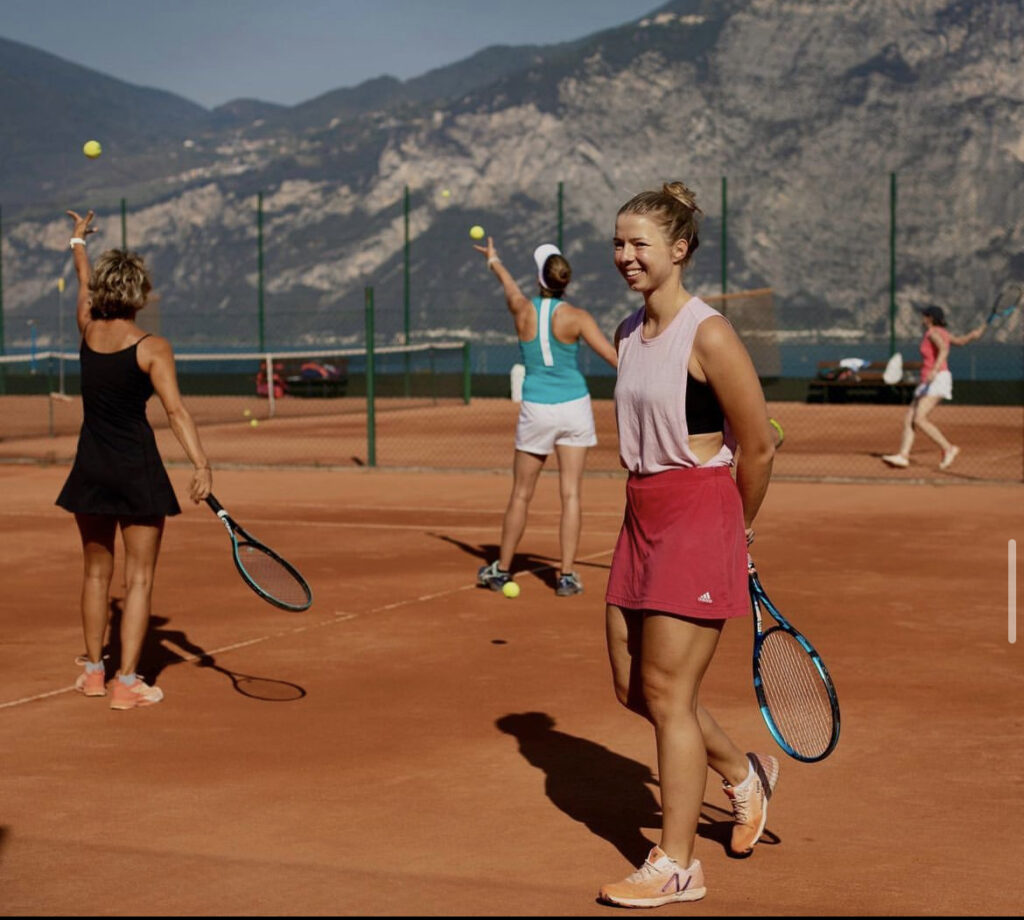
In my tennis community 70% of the players are expats as well, mostly corporate professionals. You’d be surprised what people tell you during training. It’s usually the thing they didn’t say in the meeting.
Add 500+ hours of 1:1 coaching on top of that, and I understand the dynamics and the differences well.
How I run it
When I work with your team I really care to make it as personalised as possible. That’s why I ask you beforehand what your team is dealing with.
Practice is the most important part for me. Every communication framework sounds easy on paper. It gets much harder when you have to use it on a real case.
For each workshop I prepare an individual workbook, so everyone can be brutally honest without having to share it. It speeds up the aha moment.
What people wrote afterwards, anonymously:
“A mix of both theory and context, together with exercises and role plays and practical tips to apply it makes it easily digestible.”
“I found it extremely valuable to realize that I am not alone in facing certain challenges.”
participants, Radancy DACH
▶ VIDEO SLOT — 90 seconds, Paulina on how she runs a room
● SELECTED WORK
The work, and who it was for.
One workshop that became a year
The situation. Two high-performing Customer Success teams — Germany with agency-partnership DNA, Austria shaped by a startup environment — had to become one team with shared ownership, while stepping up from delivery partner to a revenue-aligned growth function.
The work. A multi-session programme across both countries: prioritisation and communication frameworks, resilience and ownership — every concept practised in role plays built on their real customer situations, online and in person.
The result. Siloed excellence became shared ownership across borders. A more structured, value-first communication style. Managers visibly more confident in difficult conversations, and improved psychological safety at every level.
Open to change, under real pressure
A full-day offsite for a data and insights team navigating rapid change — building the adaptability and resilience a team needs when the tools and the structure keep moving underneath it.
Train For Pressure
Mental performance under deadlines, stakes and scrutiny — trained the way it is trained on a tennis court, then translated directly into how the team makes decisions when it actually counts.
The resilience condition, delivered where the pressure is highest.
Say It Clearly
Assertive communication and feedback for an international group of researchers — saying the hard thing, across cultures and hierarchies, without breaking the relationship.
The communication condition, in a room where nobody shared a first language.
Also delivered: stress management and resilience for a corporate team in London.
Your engagement numbers came back low. Now what?
Gallup asked the whole world this year, and Europe came last: 12% of people are engaged at work. Whatever your number is, it isn’t a verdict on you.
A score tells you something is wrong. It doesn’t tell you what to do on Monday.
So I come and talk to your team.
One by one, where people say the things they’d never write in a form with their name on it. Nothing comes back to you attributable. That’s what makes them honest.
Then I help your team turn it into a plan they’ll feel part of.
You’ll get the real picture. And we decide together what’s worth doing next, and whether you want me to help you keep building a team that performs sustainably.
● YOUR QUESTIONS
Team friction is already on your P&L — it is just not labelled. Delayed decisions, stress-related absence, and replacing the people who quietly decided to leave months before they told you. Team development is one of the few line items that reduces several of those at once.
If your team is stuck in meetings about meetings, you are already losing the time. Most engagements start at 2–3 hours, and the point is to remove the bottleneck eating your calendar — not to add to it.
Because we agree beforehand what should be visibly different, in your language and your metrics — fewer escalations, faster decisions, less attrition on a specific team — and we check against that afterwards. One honest measure beats a satisfaction score.
Most training doesn’t. Researchers put the average at 10 to 15% reaching the actual job. That’s why we finish with one behaviour your team commits to, and why I come back afterwards to see whether it happened.
Yes — and I know exactly where my remit ends. As a licensed Heilpraktikerin für Psychotherapie in Germany, I know where coaching stops and clinical work begins, and I say so out loud when we get there.
We work that out on the call. One team of up to 15. A bigger workshop for 50+. Several sessions over weeks. Or an offsite with Urban GetAway. English, German or Polish, online or in person.
It starts with a discovery call. Once I understand what is actually going on, you get a concrete, tailored proposal — usually within a day.
Tell me what’s going on with your team.
Thirty minutes, no pitch. You will leave with a read on what is actually happening and a tailored proposal — or an honest answer that I am not the right person, and a pointer to someone who is.
Not ready to talk yet? Send me the situation in two lines and I will tell you what I would do about it.
makol.coach@gmail.com